
D-Wave’s stagnant revenue, escalating costs, and uncertain commercial adoption point to a business that was always meant for Wall Street, not selling quantum compute.
When D-Wave reports its Q3 results in November, it will signal the end of their investment thesis. We’ve already seen all the evidence for a year about why their commercial case is collapsing, and their gate model is nothing but a lab experiment at this point.
Here’s a summary of what we know so far about the company, and what you should expect.
D-Wave’s Financial Performance Does Not Match the Hype
How can a company with zero revenue growth, claim to be commercially successful?
That’s the question all D-Wave investors need to wrestle with, when they buy or even hold this stock. In Q2 2026, D-Wave reported just $3.08 million in revenue, which was even down from last year ($3.10 million). This was 24% below cited analyst consensus (they have always been wrong on this company).
This is not a new trend, and Coherence has been seeing this for awhile. D-Wave’s QCaaS revenue has remained flat, below $2 million per quarter after more than two years. In other, revenue from actual usage of their technology has remained flat, despite the flashy press releases.
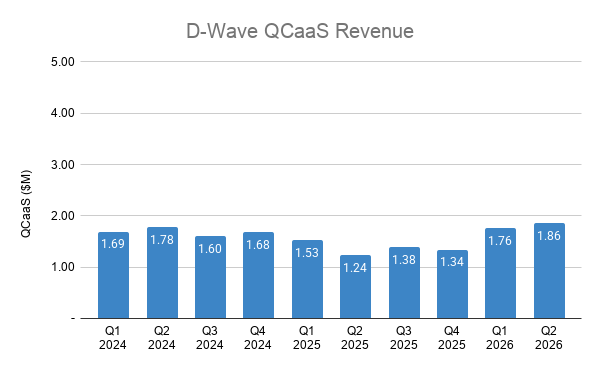
There are also major concerns about their rising costs – every $1 of revenue costed them $18 of operating expenses. But investors in QBTS do not care about that. They are chasing the revenue growth story; and unfortunately, the revenue growth is zero.
Customer Adoption: Logos Are Not Revenue
D-Wave promotes its relationships with major corporations. Investors should separate 3 things: announced customers, experimental projects, and businesses that actually rely on the technology.
D-Wave’s engagements begin as proofs of concept. A proof of concept is a paid test, and in no way guarantees future revenue. It doesn’t even guarantee that the company will find the technology is useful. They are spends a small amount to see whether a technology can help with one problem. It is not a commitment to use it in daily operations, which is where the real revenue comes from.
Trial accounts and small exploratory contracts can make adoption look broader than it is. A long customer list does not show how much each customer spends, or whether any of them run the technology in production. Retention has the same limit. A customer that stays is not necessarily spending more or using the product for real work.
The recent AT&T projects follow the same pattern. They are one-off business cases, comparable to a project a consulting firm like McKinsey would deliver. There is no repeat business and no recurring revenue. Understanding this is vital to understanding why there is no recurring revenue.
Technology: Why Quantum Annealing Struggles With Real-World Problems
As D-Wave insiders will attest to: the company’s technology is simply unmarketable and borderline unusable. D-Wave’s flagship product is a quantum annealer, which is built for a narrow set of tasks: very specific optimization and sampling tasks.
Headline qubit counts overstate what the machine can do. A processor’s physical qubit count does not translate directly into the number of fully connected variables it can represent. A big qubit number does not mean the machine can handle a problem of that size. But more importantly, the quantum annealer only deals with a subset of mathematical optimization functions, which seldom exist in the real world.
That is why large enterprise problems often require hybrid computation. The problem is that when you dive into the details of how D-Wave’s annealer works, we find that it is slower than existing solutions (often free or highly commoditized software) and that they have almost zero quantum computing integrated in the calculation. In essence, the only reason they use the term “quantum” when it comes to their hybrid solver is for marketing purposes – although by now, most experienced engineers already understand the software is useless.
Capital Allocation: The $550 Million Gate-Model Bet
In January 2026, D-Wave acquired Quantum Circuits for $550M. For comparison, this is roughly 10 quarters of current operating expenses, or about 45 years of revenue at the Q2 run rate.
The deal puts D-Wave in 2 different quantum computing architectures at once: annealing and gate-model. There is no economy of scale here, as evident by the rampant engineering hiring afterwards. Each model requires its own research program and its own resources, on top of a cost base that is already growing far faster than revenue.
The gate-model side is commercially useless, and lags even the worst computer models currently being developed. Coherence Report’s industry scorecard ranked D-Wave’s gate-model roadmap last among the providers it evaluated. And obviously its current technology could not even be reliably scored, since they are so far behind competitors. There is simply no reason to believe that the gate model will ever be competitive with the better resourced companies likes IBM, Google, IonQ, or Quantinuum.
Valuation and What Comes Next
Investors are already losing patience. D-Wave closed at $11 on October 19, 2026, down from $26 at the end of 2025. That is a drop of about 55% this year. In the week to October 14 alone, the shares fell another 21% and closed at their lowest point of the past year. The company’s market value is now less than $5B.
This despite positive buzz from the government’s CHIPS Act awards (which D-Wave itself received) and other positive trends for the broader quantum industry. Attention on the sector has rarely been higher:
- CHIPS Act: In May, the Commerce Department signed letters of intent for $2.013B in CHIPS Act incentives to 9 related companies, including $1B to IBM to build a quantum foundry. On September 8, D-Wave finalized its award of up to $100M, with the government taking a minority equity stake in the company.
- Defense: On October 8, the Department of War announced about $350M in new quantum computing initiatives. A day earlier, DARPA named the finalists in its quantum testing program. D-Wave was not among them, because its annealing machines sit outside the program’s core question.
- Private capital: Venture investment in quantum reached $4.9B in 2025, more than double the prior record (source).
- Other governments: The UK committed up to £2B to quantum in March, and Canada signed a CAD $195M agreement with Xanadu in August.
The money is flowing into the sector. It is not flowing into D-Wave’s stock.
Meanwhile, revenue at most other companies in the industry has been going up, the opposite direction of D-Wave. IonQ reported Q2 2026 revenue of $80.1M, up 287% year over year, and raised its full-year guidance to $280M to $290M. Quantinuum, which went public in June, reported $8M, up 279%, and guided to $28M to $32M for the year. Rigetti, still a small business, reported $5.1M, up 185%. A year ago, D-Wave’s quarterly revenue was larger than both Quantinuum’s and Rigetti’s. Today it trails both.
Another bad quarter will permanently send this stock down, and finally reveal what Josh Speyer, founder of Coherence Report and former D-Wave insider, has been forecasting for a year. Our estimated valuation is between $5 per share, based on the lack of product traction and the company’s future revenue potential.