
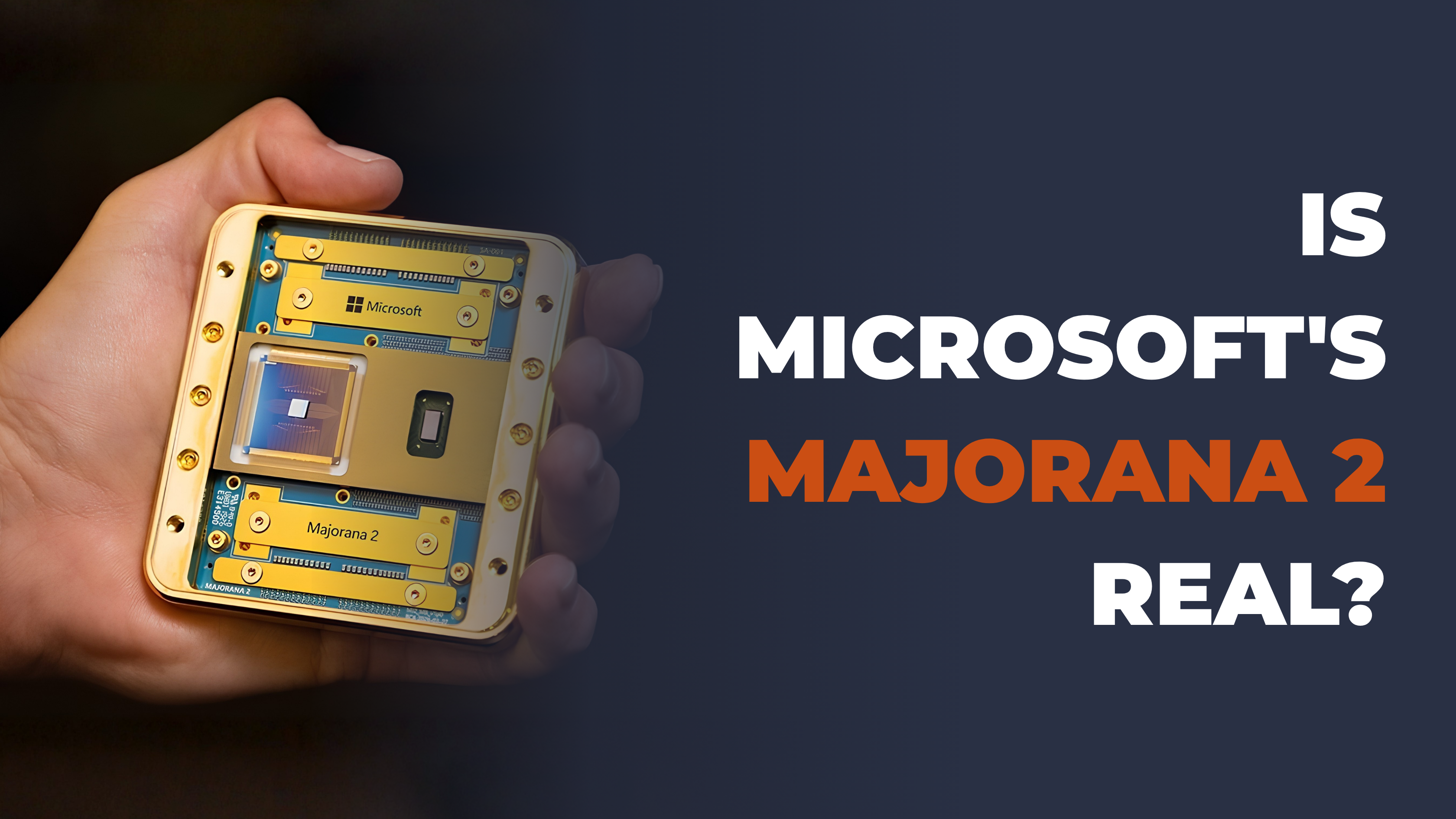
Microsoft's Majorana Might Not Exist... but it Cleared Peer Review?
Outside physicists disputed the results the same day Microsoft announced them. The company's 2029 target depends on a foundational claim that independent researchers say remains unverified after more than a year of asking for the data.
Microsoft unveiled Majorana 2, its next-generation quantum chip, at the Build developer conference on June 2. The new version swaps out the aluminum used in the previous chip for lead, a materials change Microsoft credits its Discovery AI platform with helping design.
The headline claim is stability. Microsoft says the chip holds its quantum state for 20 seconds on average, with some instances lasting a full minute, a 1,000-fold improvement over Majorana 1. On the strength of that, the company cut its timeline for a scalable quantum computer in half and now targets 2029.
Physicists pushed back the same day. Henry Legg of the University of St Andrews told Science News that nothing in the preprint resolves the underlying problems. Sergey Frolov of the University of Pittsburgh told Scientific American that the work does not rest on a solid foundation.
The skepticism is not new. When Microsoft published its Majorana 1 results in Nature in February 2025, the journal's editors attached a note stating the results did not amount to evidence for the exotic particles the entire approach depends on. Microsoft retracted a separate Nature paper in 2021. And on June 24, three weeks after the Majorana 2 announcement, Nature published a formal peer-reviewed challenge from Legg, with Microsoft's rebuttal in the same issue.
- Here's why the gap between what Microsoft claims and what physicists accept matters so much: a 20-second qubit lifetime in this kind of system would be extraordinary. Today's best superconducting qubits from IBM and Google hold their state for microseconds. and a 20-second claim is magnitudes better. That's either a genuine breakthrough, or it's a case of measuring the wrong thing and calling it something it isn't.
- If the topological approach really works, it offers something no other design can match: potentially millions of qubits on a single chip, with error protection built into the hardware itself rather than needing huge numbers of extra qubits just for error correction.
- Microsoft has been chasing this approach since around 2016. This isn't the first time the company has announced a result the outside physics community couldn't reproduce. This makes it the third time in a row that an announcement has come before independent confirmation.
We're going to deep-dive into these developments, because the entire Majorana is fascinating and under-reported. While most of quantum computing is well understood, the scientific community is not even clear yet whether the Majorana even exists. Microsoft is not in the habit of producing vapor-ware, so we have to give them the benefit of the doubt here... but the story just does not add up.
Whether the Majorana 2 preprint clears peer review. Watch for submission to Nature, Science, or Physical Review Letters and what comes back. If reviewers return the same objection Legg raised, that the result measures classical parity rather than quantum coherence, the 2029 roadmap loses its scientific footing in public rather than in a preprint comment thread. The fate of the still-unpublished July 2025 preprint. Microsoft's X-measurement paper for Majorana 1, the one that would address the superposition question, has sat on arXiv for roughly a year without appearing in a journal. If it is quietly abandoned or formally rejected, that becomes a second unpublished topological result sitting next to the 2021 Nature retraction, which is harder to characterize as an isolated stumble. Whether any outside lab attempts replication. This is the single most informative thing that could happen and the least likely to be announced with a press release. What Microsoft says next matters less than whether an independent university or national laboratory builds a lead-based device and reports what it finds. Both Legg and Microsoft have called for independent replication, which means neither side has an excuse if it doesn't happen. Quiet movement on the 2029 date. Microsoft halved its timeline on the strength of an unreviewed preprint. If review goes badly, watch the earnings calls and investor materials for the date to drift back without anyone addressing why. The Quantinuum contrast. Helios is the control group. Sandia National Laboratories evaluated the 98-qubit system, and the results were published in Nature after peer review, with a two-qubit fidelity of 99.921% and single-qubit fidelity of 99.9975%. That paper started life as an arXiv preprint too, and then finished the journey. If Microsoft's results remain unconfirmed twelve to eighteen months from now while trapped-ion and superconducting competitors keep clearing independent verification, the comparison does the argument on its own.
Prudence is required, and investors tend to get burned by following one company's claims vs. scientific community validation. But this is fascinating and should be followed.
Physical Qubits vs. Logical Qubits: Why the Headline Number Rarely Tells the Whole Story - https://coherence.report/physical-qubits-vs-logical-qubits-why-the-headline-number-rarely-tells-the-whole-story/
Calibration and the Future of Quantum - https://coherence.report/calibration-and-the-future-of-quantum/
What the Binary Constraint Limitation Means for Quantum AI- https://coherence.report/what-the-binary-constraint-limitation-actually-means-in-real-life/
Microsoft Majorana 2 announcement (materials, lifetime claims, 2029 roadmap): https://news.microsoft.com/source/features/innovation/majorana-2-microsoft-discovery-agentic-ai/
12-qubit count confirmed (via BBC): https://www.datacenterdynamics.com/en/news/microsoft-unveils-majorana-2-quantum-chip/
Henry Legg's "would never make it through peer review" quote: https://www.scientificamerican.com/article/microsofts-upgraded-majorana-quantum-computing-chip-fizzles-with-physicists/
Legg's "classical bit" characterization: https://www.theregister.com/research/2026/06/24/boffin-claims-microsofts-supposed-quantum-leap-does-not-compute-due-to-basic-python-errors/5260489
Legg's peer-reviewed Nature "Matters Arising" critique, published June 24, 2026: https://windows.gadgethacks.com/news/nature-publishes-formal-challenge-to-microsoft-majorana-1-quantum-claims/
2025 follow-up preprint still unpublished: https://postquantum.com/industry-news/microsoft-majorana-2-analysis/
2021 Nature paper retraction background: https://www.scientificamerican.com/article/microsofts-upgraded-majorana-quantum-computing-chip-fizzles-with-physicists/
Quantinuum/Helios Sandia certification for comparison: https://quantumcomputingreport.com/sandia-national-laboratories-and-quantinuum-validate-98-qubit-helios-trapped-ion-framework/