
D-Wave and Japan Tobacco published a peer-reviewed paper in Scientific Reports on July 9 describing quantum-assisted molecular design. The paper is open access, the tables are complete, and the methods are specified in enough detail to audit; and in total represent a legitimate machine learning contribution. That is more than most quantum computing announcements survive.
What it does not contain is evidence of quantum supremacy, a commercial efficiency case, or a demonstrated capability that conventional software lacks. The majority of the reported improvement comes from a classical algorithm the authors developed. The quantum “contribution” that remains appears in one of the two model architectures they tested, and effectively vanishes in the other. It is measured by two automated scores that carry no information about therapeutic value, against an in-house baseline whose compute budget is never disclosed, in a single run with no reported variance.
What the Quantum Annealer Did
The generative AI model operates, by treating molecules as text. Chemists have a standard notation, SMILES, that writes a compound as a character string. For example, aspirin is represented as:
CC(=O)OC1=CC=CC=C1C(=O)
A transformer model, the same architecture underlying large language models, reads those strings and learns the statistical patterns within. It was trained on roughly 129,000 compounds from ChEMBL, a public bioactivity database.
Architecturally, this model is an autoencoder. An encoder compresses each molecule down to a fingerprint: 128 yes-or-no values that capture what distinguishes it. A decoder takes a fingerprint and rebuilds a full molecular string from it, one character at a time. To generate novel compounds rather than reconstructions, the system needs a supply of plausible fingerprints it has not seen before.
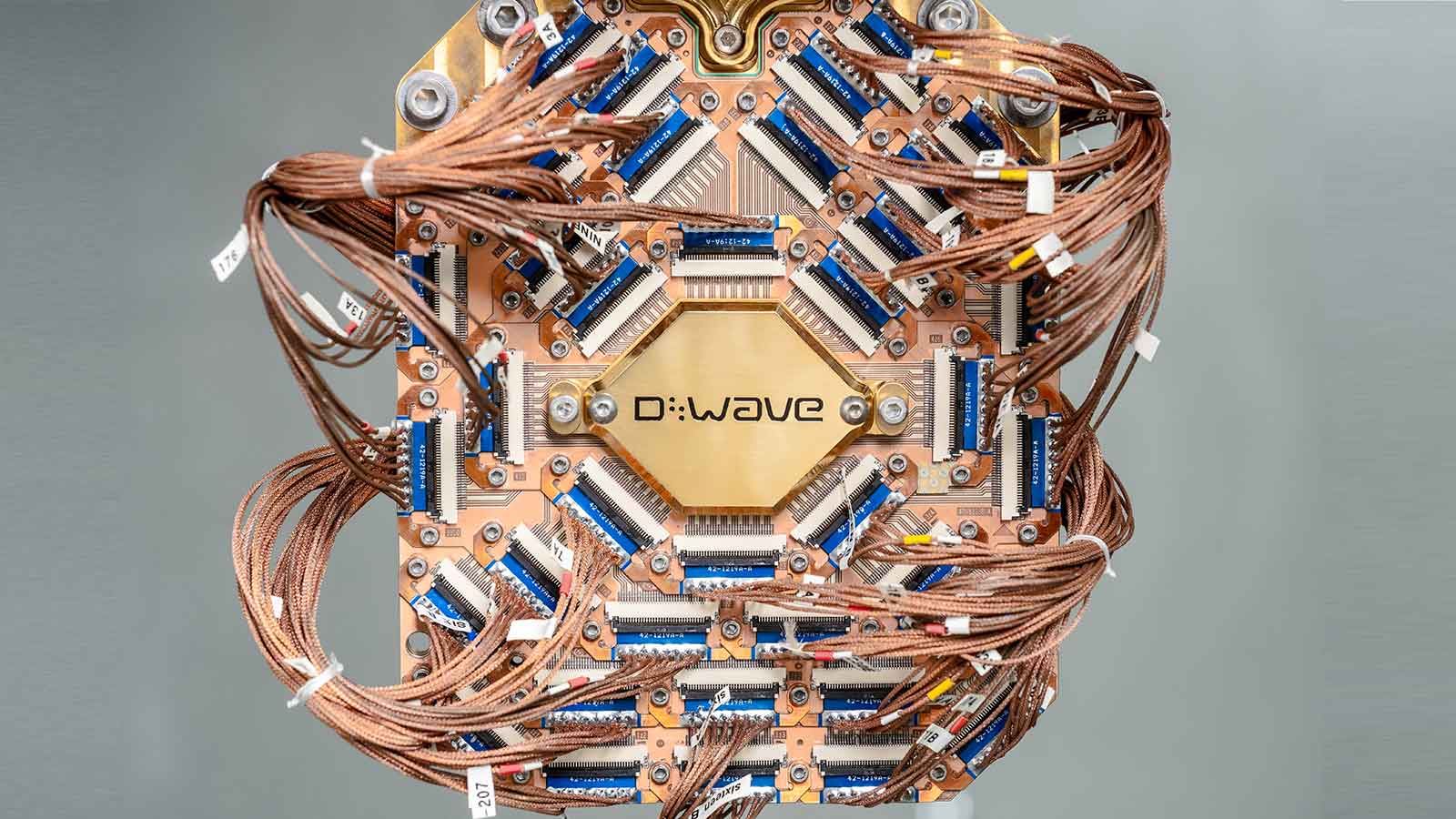
Sampling from that network is the computational bottleneck, and it is the only point at which the quantum processor appears. The conventional approach uses simulated annealing, a classical algorithm. The experiment substitutes a D-Wave Advantage2 processor, which finds low-energy configurations of the same network in hardware.
That is the entire quantum contribution: generating fingerprints from a trained distribution. This represents between 0.05% to 0.5% of the model’s performance.
No molecular structure is encoded on the QPU. No atoms, bonds, geometry, or electronic properties. The network weights were learned from data, and the quantum annealer has absolutely no programming or design that is domain-specific to chemistry.
The contrast worth holding is the IBM and Cleveland Clinic result from March 2026, which simulated the electronic structure of a 303-atom miniprotein on Heron QPU. There the qubits represent physical degrees of freedom in an actual molecule. Whether that scales to drug-relevant systems is genuinely contested. But the chemistry is on the device. Here, every chemically meaningful operation runs in conventional software, and the annealer only supplies structured randomness.
What was D-Wave’s Quantum Effect?
Two variables changed across the experiments, and the headline numbers stack both.
The first is a new loss function the authors call the Neural Hash Function, which solves a longstanding problem in training models that use discrete internal representations. It is entirely classical and runs on standard GPUs. It is also, on the evidence of this paper, a legitimate contribution that would be publishable with no quantum component at all.
The second is the sampler: classical simulated annealing versus the D-Wave processor.
The paper makes three claims:
- The new loss function beats the prior method.
- Quantum sampling beats classical sampling.
- Generated molecules score higher on drug-likeness than the training data they learned from.
Unfortunately for D-Wave, classical AI engineering drove most of the improvement, and the quantum sampler added only an inconsistent increment on top of it.
Inconsistent is the operative word. On the transformer architecture, swapping in the quantum sampler is worth 20-35% of validity. That is a large gap and should not be minimized. On the MLP architecture the authors also tested, the identical swap is worth 0.8 and 1.6 points. Drug-likeness is not reported for the MLP models at all, so the second headline metric cannot be checked in the configuration where the quantum effect disappeared.
One issue is that these numbers could very well have been cherry-picked. Variance cannot be ruled out, because every number in the paper comes from a single training run. Reporting a 25-point gap from one run is the methodological equivalent of citing a single quarter as a trend.
But by far, the greatest problem is what the validity was measured against. Every figure is internal… in other words, the author never benchmarks against methods that other practitioners currently use. It makes exactly one external comparison, to a 2023 paper that is itself a quantum annealing hybrid and the source of its training data.
This means that although the annealer showed a tangible effect, there is no evidence that this effect couldn’t have been reproduced or even exceeded, using other common methods.
This is not Quantum Supremacy
The terms in this field get used interchangeably and should not be. There are four distinct claims, in descending order of significance.
Supremacy, or quantum advantage, means a quantum machine doing something a conventional computer effectively cannot do at all. Computational advantage means doing the same job measurably faster or cheaper. Quality advantage means doing the same job with better output on some metric. Feasibility means the thing runs.
This paper claims the third: Quality advantage. It makes no claim to quantum supremacy, and given the missing baseline disclosures and the absence of repeat runs, it only vaguely supports quantum advantage.
The authors deserve credit for being careful about this. Their language is that the quantum version “outperforms the classical counterpart,” that the approach “could be used,” that it “should possess a powerful potential,” and that hybrid modeling is “promising.” The word supremacy never appears.
Here’s our stance on the future of D-Wave (QBTS).
Benchmarking Metrics Used
This entire Quality Advantage claim rests on two metrics: Validity and Drug-Likeness.
Validity is the fraction of generated strings that parse into a chemically legal molecule. It is nothing but a syntax check on the SMILE text string. In other words, this is like testing a meaningless phrase: “Colorless green ideas sleep furiously” for grammar.
Drug-likeness measures how closely a compound resembles drugs already on the market. It does not measure against the dimensions that truly matter to molecule generation: toxicity, efficiency, or effectiveness.
The paper’s own uniqueness column supports this reading. The 97% validity configuration reports only 51.9% uniqueness, meaning roughly half its output is duplicated. The classical configuration reports 98.1%.
Two further measures are missing. Novelty, the share of generated molecules not already present in the training library, is the standard third metric in this field and is absent. Without it, memorized recombination cannot be distinguished from genuine generation.
Synthetic accessibility, the one metric bearing on whether these compounds could physically be made, appears in a chart but never as a number in any table.
The Industry has Skipped D-Wave
Litigating a single experiment has limited value. The more durable signal is procurement, because it reflects allocation decisions by organizations with computational chemistry staff capable of evaluating the technology. At the end of the day, this all that matters to investors… not a published paper.
The rest of the quantum computing is pulling far ahead of D-Wave:
Trapped-ion systems. Amgen engaged Quantinuum around 2019 on computational biology and was so successful that it participated in its $300 million equity round; converting from customer to shareholder. IonQ operates a dedicated applications center inside AstraZeneca’s BioVentureHub. Roche worked with Cambridge Quantum, now part of Quantinuum, on molecular modeling. Mitsui, QSimulate, and Quantinuum launched a joint chemistry platform targeting drug and materials discovery. Qubit Pharmaceuticals is validating drug discovery algorithms on Quantinuum H2 and Helios systems through Singapore’s national quantum program.
Superconducting systems. IBM holds agreements with Moderna, explicitly covering quantum computing combined with generative AI for mRNA design, and with Takeda. IBM and Cleveland Clinic published the miniprotein electronic structure work in March 2026. Boehringer Ingelheim works with Google Quantum AI on drug discovery algorithms.
Neutral-atom systems. Pasqal has engagements with Sanofi and BASF, and Qubit Pharmaceuticals used Pasqal’s Orion system to model water placement inside protein binding pockets, which bears directly on predicting whether a drug will bind. Merck and Amgen have both engaged QuEra.
While D-Wave is the loudest of these companies, in publicizing their only molecule generation project; we see that they are far behind the rest of their quantum computing peers.
The Data
| Architecture | Loss function | Classical sampler | Quantum sampler |
| Transformer | Prior method | 52.2% valid, 40.8% drug-like | 71.9% valid, 52.6% drug-like |
| Transformer | New (NHF) | 62.0% valid, 43.2% drug-like | 97.0% valid, 66.8% drug-like |
| MLP | Prior method | 38.5% valid | 39.3% valid |
| MLP | New (NHF) | 58.3% valid | 59.9% valid |
About the Citations and Claims
D-Wave’s actual supremacy claim does not rest on this paper. It rests on separate physics experiments, published in Nature in 2023 and Science in 2025, involving spin-glass simulations that have nothing to do with drug discovery and have drawn classical-simulation counterclaims from other research groups.
Those papers appear in this one, cited in the introduction as the justification for trying annealing at all. The resulting structure is circular. A contested physics claim enters a drug paper as settled background. The drug paper produces carefully hedged findings. Those hedged findings are then promoted as validation of the physics claim. Each stage is more confident than the one before it, and none of them independently establishes anything. This paper does not corroborate the supremacy claim. It presupposes it.
Citation
Kunugi, H., Rahmani, M., Iyama, Y., Hirono, Y., Suma, A., Woolway, M., Vargas-Calderón, V., Kim, W., Chern, K., Amin, M., & Tateno, M. (2026). Molecular design beyond training data with novel extended objective functionals of generative AI models driven by quantum annealing computer. Scientific Reports. https://doi.org/10.1038/s41598-026-49186-8
URL
https://www.nature.com/articles/s41598-026-49186-8